

11/03/2026
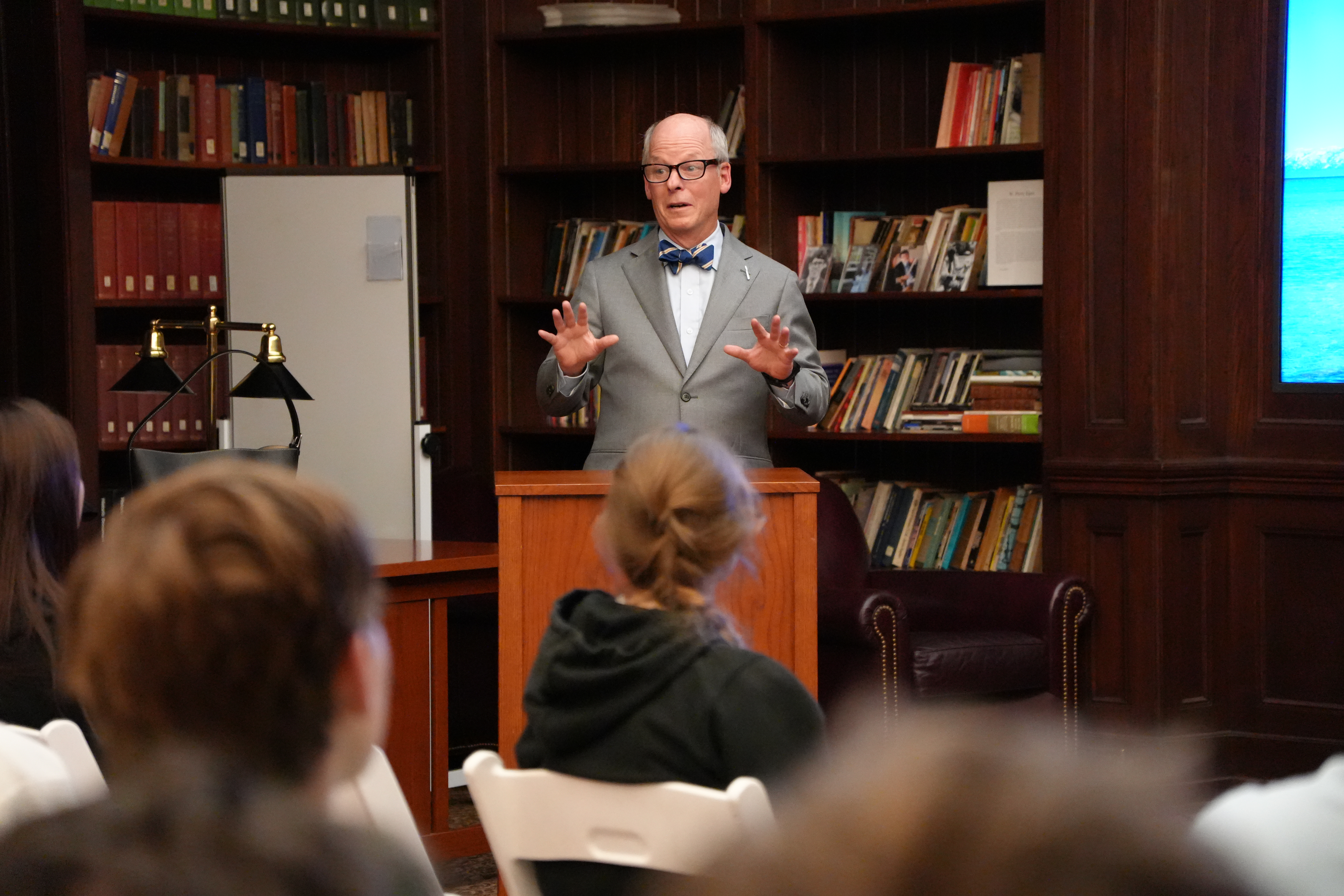
On a recent fall evening, four distinguished surgeons stepped away from their American College of Surgeons conference in Washington, D.C., to spend the evening sharing knowledge and life lessons with Episcopal’s biology students. In a panel moderated by Dr. William B. Inabnet ’83, three female surgeons shared the paths that brought them to the top of their fields. Their stories could hardly have been more different, but they kept returning to the same ideas: perseverance, teamwork, and service. The students, for their part, came with questions.
A Chance, a Waitlist, and the Value of Perseverance
Dr. Inabnet, Chair of the Department of Surgery at the University of Kentucky College of Medicine, opened by telling students that the physicians beside him were at the top of their fields and had chosen to be in the room. Then he offered his own story. He was admitted to Episcopal off the waitlist in July and is the first to say he was simply given a chance by an administration who believed in him. He was not the best student, he admitted, but he truly learned how to study here.
“For those of you who don’t think you’ve got it, you’ve got it,” he said. “Hard work, discipline, perseverance is the name of the game.”
Look for the Gaps, Embrace the Struggle, Choose Hard Things
Dr. Nancy Perrier, an endocrine surgeon at UT MD Anderson Cancer Center and dean of a medical school, urged students to look where others aren’t. “Don’t look for the easy route. Look for where the gaps are. That’s where the science is.” Many people lead without the title, she said, often from behind, and obstacles become openings for those who follow. “We learn when we’re challenged the most,” she told them, and then we realign, retarget, and refocus. Her charge: Find a mentor this year, then be one for someone younger.
Dr. Danielle Walsh, a pediatric surgeon at the University of Kentucky College of Medicine, grew up in a trailer home and described herself as the child ignored at the back of the classroom, never class president and never on a team. What she had was a willingness to work, watch, listen, and learn. “What really matters is the character within you and your determination to overcome and learn from any circumstance that you’re in.”
Dr. Beth Stuebing of Christian Health Service Corps grew up in Zambia and now works as a trauma and critical care surgeon in Malawi. She offered a lesson well suited to a generation raised on instant results: anything worth doing is hard, takes a long time, and requires teamwork. “Easy is boring.”
Will Robots Replace Surgeons? Students Look to the Future
Students were eager to look ahead. One asked whether advances like robotic surgery might one day replace surgeons altogether, and whether new kinds of jobs would emerge in medicine.
Dr. Walsh, an authority on surgical intelligence, said that for the next decade technology will mostly augment surgeons. Robots will gradually take over the easier operations, she explained, while humans handle the complicated ones. “The nature of our job is going to become more intensive,” she said, which will change who becomes a surgeon and how surgeons are trained. She offered a glimpse of the frontier: Traditional surgery is impossible on a space station, since blood and anesthetic gases would simply float away, but robotic and laparoscopic techniques, where instruments work inside the body, make it conceivable. Humans, she said, will remain “in the loop” for a long time to come. “We need you in these fields.”
Other students wanted to know about the moments that shaped the surgeons themselves. One asked whether any single operation stood out in memory. Dr. Perrier described the first time she felt truly part of a team: As a medical student, she held the camera during a laparoscopic adrenalectomy on a patient she had met during her internal medicine rotation and had been unable to help. Surgery cured her in short order. “For me that was, without a doubt, the ‘I’m going to be a surgeon’ moment.”
Another asked how each panelist chose a specialty, which brought out some of the evening’s warmest stories. Dr. Inabnet’s answer came back to his own pivot. Failing to match in vascular surgery sent him down the path to endocrine surgery and a year of training in Paris. His takeaway: “When you fail, learn how to pivot, don’t beat yourself up, keep moving forward.”
Success Can Take Many Forms
For Candace Igyan ’27, the variety was the point. “I found it intriguing that each of them, although in the same field, have had such varying experiences,” she said. “As a young woman approaching the age of entering into the workforce, their insight to me was invaluable.”
“As I am on my college application journey, I have been posed with the question of what I want to do in the future. This talk made me realize my contribution to the world matters and success can take on many different forms.” Though Igyan doesn’t plan to pursue medicine, she added, “I was able to take a piece of wisdom from each of the surgeons’ stories. Overall, this speaker event was immensely enriching.”
Healing Is What We Do for Each Other
Dr. Perrier offered the evening’s closing thought, one that spoke for the entire panel: “Healing is what we do for each other, and that’s the story of mankind.” Invest in people, she told the students, and invest in giving back.