
English
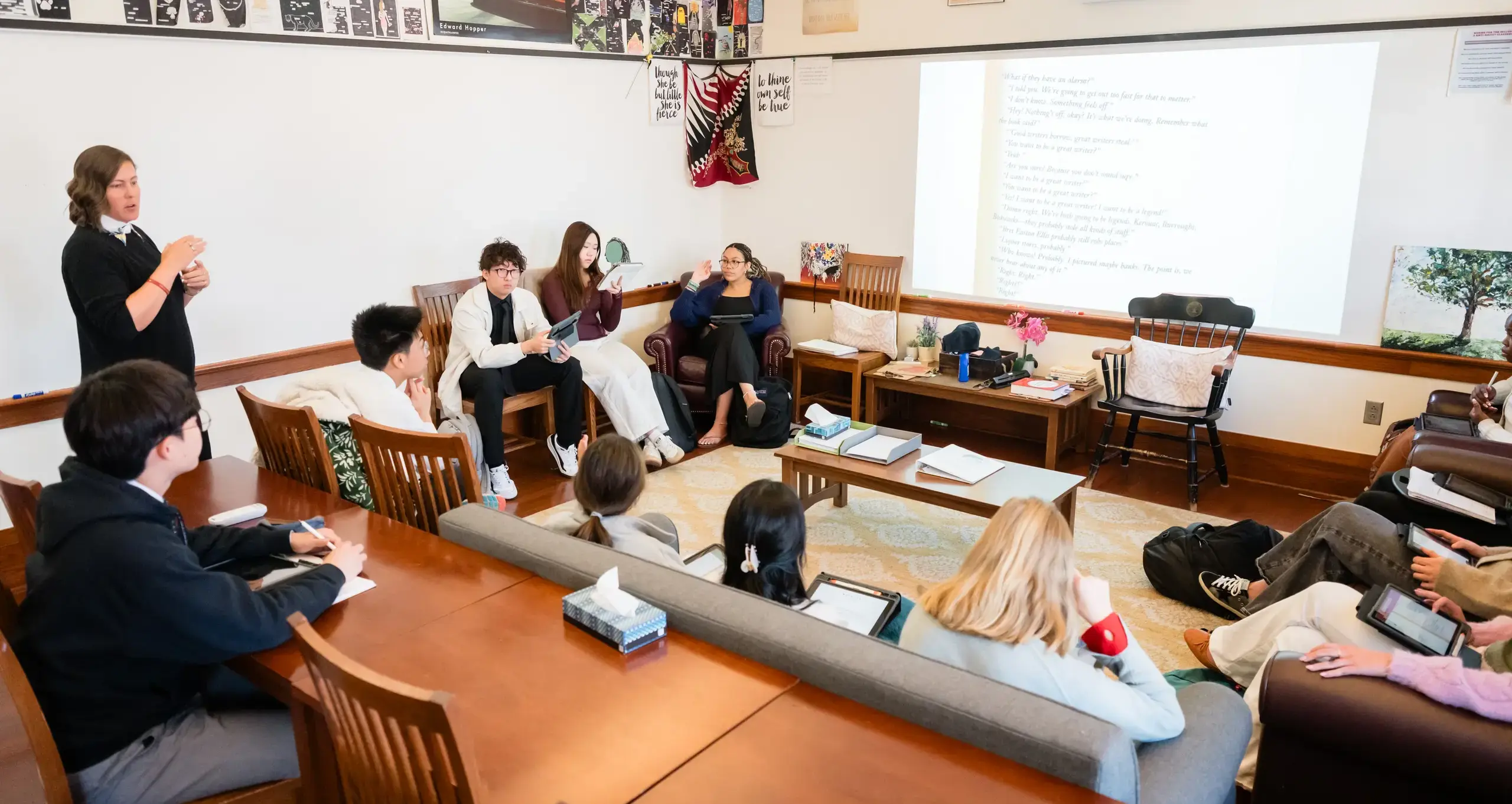
The English Department empowers students to become lifelong readers who express themselves clearly, convincingly, and creatively in writing and discussion. The English curriculum offers a broad range of courses across the four years of study, incorporating core content and skills in the ninth and tenth grade years and prioritizing student choice and interest in the student’s final two years. Students will leave Episcopal with a firm fundamental grounding in all forms of writing–analytical, narrative, persuasive, and creative. They will also develop and deepen their reading skills through encounters with a breadth of literature and a diversity of voices and styles. Additionally, students will be readers of the greater Washington, D.C. metropolitan area, visiting the community at large at least one time each semester per English class; students
Requirements: 4 credits
Four credits are required in English. Students must be enrolled in English every semester at Episcopal, and they must complete one elective that fulfills a writing requirement and one elective that fulfills an American literature requirement. The English Department recommends students for advanced English electives in the 11th and 12th grade. Should returning students wish to enroll in an advanced class without the department recommendation, they must submit an application to the Department Chair for consideration. That application will be sent to students in the spring, and it can also be found here. All incoming eleventh graders will enroll in Writing Workshop in their first semester.
Course Offerings Below
| Fundamentals in Literature and Composition: (1.0 credit, full year) 9th |
|---|
|
The Episcopal freshman-year English curriculum leverages the resources of Washington, D.C., to teach fundamental English skills through a contextual lens. By examining the relationship between a place and its communities, students learn to connect their studies to the world around them. This course’s multimodal approach will help to build a strong foundation for academic excellence by equipping students with transferable skills that foster adaptability, critical thinking, and an appreciation for how context deepens learning. As students navigate their EHS journey, this course will prepare them to engage meaningfully with their surroundings and embody the core values of our Portrait of a Graduate. The class teaches and relies on discussion, and also dedicates lots of time to writing in various forms, including personal responses, formal analytical and persuasive essays, and creative pieces. Texts may include Speak No Evil, Their Eyes Were Watching God, a Shakespeare play, as well as poetry/music and a choice novel unit to conclude the year. |
| Genre Studies (1.0 credit, full year) 10th Prerequisites: Fundamentals in Literature and Composition |
| Students review the mechanics of the English language, including grammar, syntax and vocabulary, write essays of a personal and critical nature, and craft creative fiction. Students read and trace themes through broad divisions of drama, fiction, nonfiction, and poetry, augmenting their understanding of how authors create meaning in different genres, and substantiating and specifying this understanding. Through grade-level and individual class engagements in Washington, D.C., in the theater scene, museums, historical sites, monuments, and natural areas, students deepen their learning. Core texts may include Shakespeare’s Macbeth and Sophocles’ Antigone, a novel by Toni Morrison, and a work of nonfiction about the Holocaust. |
| Advanced American Studies (2 credits: 1 English and 1 Social Studies, full-year) 11th Prerequisites: Genre Studies, Modern World History or Honors Modern World History |
|
America as place, America as people, America as culture, America as an idea–in all its manifestations, America is complex, capacious, and changing. American Studies is for the student interested in exploring the complexities of what it is to be an American, by studying the experiences and values of the people of the United States as embodied in their history, literature, and culture, including art, music, politics, fashion, food, dance, religion, folklore, and media. By taking as our particular focus the place and people of Washington, D.C., this class seeks to empower students to confront with historical awareness the most pressing problems in American society. American Studies will meet for two class periods each day, allowing time for an in-depth study of American history, literature, and culture, as well as for many off-campus experiences and alternative assessments, such as oral history, performance, debates, and other forms of rigorous, creative expression. Advanced American Studies students should be prepared to read critically, to write with clarity and nuance, and to form well-organized and creative extended arguments. This course fulfills both the U.S. History and English requirements, including the American Literature and writing requirements. |
| Advanced English Seminar: American Drama (0.5 credit, fall only) 11th, 12th Prerequisites: Genre Studies |
|
Theater has played a key role in American culture since even before the founding of the United States, and this course will explore plays that focus on essential themes in the arc of American identity. We will examine what nearly three centuries of dramatic literature have had to say about this country and its people — through various lenses — and work to define the American experience for people from all walks of life. Particular attention will be paid to diverse voices within the American theatrical scene, and theatrical works that push the boundaries of form, message, and what is culturally “acceptable.” Assignments will range from traditional literary assessments like analytical essays to in-class, Harkness-style graded discussions, to creative pieces such as planning directorial ideation and crafting American plays of our own. We will attend (and review) at least one production in the D.C. area, but generally we will do everything we can to bring these plays from across dramatic history to life. The advanced nature of this class will entail more independent, long-term work for students, a greater emphasis on scholarly research behind these plays, a higher bar for expectations regarding the understanding of American culture (through history, in particular) that students are bringing to the class, and a stricter set of standards for writing skills. This course fulfills the American Literature requirement. |
| Advanced English Seminar: American Protest Literature (0.5 credit, fall only) 11th, 12th Prerequisites: Genre Studies and department recommendation |
|
Throughout American history writers have lamented, excoriated, rebelled, celebrated, and prophesied, challenging audiences to examine their own beliefs and actions. Beginning with the American Revolution and continuing to the present, we’ll immerse ourselves in this rich literary tradition. Our discussions will be grounded in both history and literature, but they will go beyond that, drawing on film, art, and music and will be organized into three broad categories: race, gender and sexuality, and environment. In each of these categories, we will consider how the protest of thought and behavior shapes the course of our collective, national lives, as well as our own individual lives. We will take advantage of museums, organizations and individuals in the D.C., metro area, and students will delve into a personal interest through an intensive individual research project and educate their peers about their findings. Students will also write personal responses and analytical reflections on the reading throughout the course, and the major writing assessments will be numerous and varied--creative writing, close-reading analysis, and compare and contrast. Students in advanced courses should be prepared to write with clarity and technical proficiency and to display critical and creative thought in extended arguments. |
| Advanced English Seminar: The Art of the Epic: The Odyssey and Its Adaptations (0.5 credit, spring only) 11th, 12th Prerequisites: Genre Studies and department recommendation |
|
This course is a chance for students to take a deep dive into Homer’s ancient epic poem, The Odyssey - to experience and wrestle with the timeless story of the hero’s journey and to study a sampling of the countless adaptations it has inspired over the centuries, in particular the more modern novels, poems, and stories such as The Penelopiad, by Margaret Atwood, Cold Mountain, by Charles Frazier, and Circe, by Madeline Miller. We will also explore music and art work inspired by The Odyssey. Students should expect to participate in critical and close reading, Harkness discussion, creative writing, and analytical writing in this advanced class. For non-senior students, advanced second semester classes will continue through the end of May, culminating with a final exam. One week will be given in May to instruction of the college essay. |
| Advanced English Seminar: Chekhov (0.5 credit, spring only) 11th, 12th Prerequisites: Genre Studies and department recommendation |
|
This course focuses on the work of Russian author Anton Chekhov (1860-1904), whose short stories and plays are foundational texts in modern literature. Beginning by placing Chekhov in the context of late 19th century Russian literature and history, the course will examine his work as it increases in insight and subtlety across his short career, culminating in the extraordinary pieces produced in the last years of his life. The course will also consider at least one of Chekhov’s four major plays: The Seagull, Three Sisters, Uncle Vanya and The Cherry Orchard. The course is discussion-based, and students will keep a reading journal throughout the semester. Assessments may include essays, creative writing, timed papers, graded discussions, acting, and a culminating project focused on independent reading. For non-senior students, advanced second semester courses should be prepared to write with clarity and technical proficiency and to display critical and creative thought in extended arguments. Advanced second semester classes will continue through the end of May, culminating with a final exam. One week will be given in May to instruction of the college essay. |
| Advanced English Seminar: Contemporary Global Literature (0.5 credit, fall only) 11th, 12th Prerequisites: Genre Studies and department recommendation |
|
This discussion and reading-based semester course will examine global literature published in the current millennium. By digesting literature from around the world, students will be exposed to various cultural, political, and social platforms, thereby engaging with numerous perspectives. A variety of writing exercises, both creative and analytical, will supplement students’ understanding and discussion of the text. In addition to in-class work, students will complete three asynchronous choice novel projects over the course of the semester. By the end of the semester, students will have read seven novel-length texts. The culminating project is a combination of creative and analytic, allowing the student freedom to craft and present a visual analysis of any material read in the semester. Authors encountered in the course may include Adichie, McEwan, Jones, Nelson, Madden, Sedira, Woodrell, Khalifa, and Kay. Students in advanced courses should be prepared to write with clarity and technical proficiency and to display critical and creative thought in extended arguments. |
| Advanced English Seminar: Contemporary Global Literature (0.5 credit, fall only) 11th, 12th Prerequisites: Genre Studies and department recommendation |
|
This discussion and reading-based semester course will examine global literature published in the current millennium. By digesting literature from around the world, students will be exposed to various cultural, political, and social platforms, thereby engaging with numerous perspectives. A variety of writing exercises, both creative and analytical, will supplement students’ understanding and discussion of the text. In addition to in-class work, students will complete three asynchronous choice novel projects over the course of the semester. By the end of the semester, students will have read seven novel-length texts. The culminating project is a combination of creative and analytic, allowing the student freedom to craft and present a visual analysis of any material read in the semester. Authors encountered in the course may include Adichie, McEwan, Jones, Nelson, Madden, Sedira, Woodrell, Khalifa, and Kay. Students in advanced courses should be prepared to write with clarity and technical proficiency and to display critical and creative thought in extended arguments. |
| Advanced English Seminar: Creative Writing: Flash Fiction (0.5 credit, spring only) 11th, 12th Prerequisites: Genre Studies and department recommendation |
|
This second semester course is designed to briefly re-familiarize students with fundamentals of writing fiction, nonfiction, and poetry, using classic and contemporary works as models that afford students a better understanding of the creative process. Throughout the semester, students will complete week-long focused studies on the elements of the short story, including plot development, setting, character, dialogue, and point of view. For assessments, students will begin to either craft a longer piece of fiction, whether through chapters, or a collection of short stories linked by character or theme. In addition to biweekly check-ins regarding progress on the final portfolio/product, students will complete self-reflective writing to showcase their process and plans. Through daily and nightly writing assignments, students can demonstrate their writing skills as well as experiment with various strategies. Students in advanced courses should be prepared to write with clarity and technical proficiency and to display critical and creative thought in extended arguments. For non-senior students, advanced second semester classes will continue through the end of May, culminating with a final exam. One week will be given in May to instruction of the college essay. This course fulfills the writing requirement. |
| Advanced English Seminar: Individualism in American Literature (0.5 credit, fall only) 11th, 12th Prerequisites: Genre Studies and department recommendation |
|
Since its inception, America has been a place where the spirit of individuality has flourished, and Americans, as a people, have long believed that independence and self-reliance are an integral part of our national character. Throughout our history, we have shown special regard for people and characters who follow their own ideals and beliefs rather than accepting the values of the masses. Over the course of the semester, we will follow those characters who stepped off the well-worn path to chart their own unique trail through the American landscape, and we will examine the complex interplay between the individual and the collective. Possible texts for the course include the following: Into the Wild, One Flew Over the Cuckoo’s Nest, The Crucible, My Antonia, and Walden. Students will be asked to write personal responses and reflections on the reading throughout the course, and the major writing assessments will be varied — creative writing, close-reading analysis, and compare and contrast. Students in advanced courses should be prepared to write with clarity and technical proficiency and to display critical and creative thought in extended arguments. This course fulfills the American Literature requirement. |
| Advanced English Seminar: Literature of the Vietnam War (0.5 credit, spring only) 11th, 12th Prerequisites: Genre Studies and department recommendation |
|
In Tim O’Brien’s The Things They Carried, our narrator suggests that “story truth” can sometimes feel truer than “happening truth.” This powerful reflection captures the way we tell stories, how we make sense of history now, and how we “carry” the past. Lively discussions, research, and close reading will help us understand how fiction, poetry, music, art, and documentaries shaped our memory of the Vietnam War and its lasting mark on American society. Guiding questions may include: Whose stories and memories from this era “carry” on, and why? What is the crucial difference between “story truth” and “happening truth”? And how does this distinction impact the way we remember history? How do authors from this time period shape the way we understand the Vietnam War? For non-senior students, advanced second semester classes will continue through the end of May, culminating with a final exam. One week will be given in May to instruction of the college essay. This course fulfills the American Literature requirement. |
| Advanced English Seminar: Literary D.C. (0.5 credit, fall only) 11th, 12th Prerequisites: Genre Studies and department recommendation |
|
From Benjamin Banneker to Charlotte Grimké, and from Edward P. Jones to Rita Dove, this course will read, walk, and write Washington, D.C. Focusing both on the outside-in view as well as the inside-in view, the class will examine American texts by both local authors, as well as authors reflecting on Washington, D.C. from outside of the nation’s capital. Guiding questions may include: What possibilities does our capital city provide for the American writer? The reader in the US? And what limitations? Flex blocks will occur frequently, and students who take the course should be those who commit wholeheartedly to making connections between literary artifacts and experiential learning in the Washington, D.C. area. The course will end with a capstone project that attempts to answer the questions “Whose city is this American capital, and what is my literary place in it?” This course fulfills the American Literature requirement. |
| Advanced English Seminar: Narratives of the Holocaust: Resistance, Resilience, and Human Courage (0.5 credit, fall only) 11th, 12th Prerequisites: Genre Studies and department recommendation |
|
This course examines the Holocaust (Shoah) through the lens of biographical storytelling. The course will focus on the various ways in which an individual’s story can be shared (e.g., literature, art, museum exhibits, and podcasts). The focus of these stories will revolve around themes of resistance, resilience, and human courage. Students will explore individual narratives through survivor memoirs, graphic novels, podcasts, museum exhibits, including extensive resources from the United States Holocaust Memorial Museum and the USC Shoah Foundation, and theological texts. By engaging with these diverse forms of storytelling, the course emphasizes the historical significance and deeply personal impact of the Holocaust, transforming this monumental history into relatable human experiences. Regular discussions will foster thoughtful dialogue and deepen their understanding of the Holocaust through the intimate lens of individual lives and stories. |
| Advanced Science Journalism: Reading and Writing (0.5 credit, fall only) 11th, 12th Prerequisites: Genre Studies and department recommendation |
| This elective course will explore the art and craft of writing about science for academic and general audiences. Students will learn strategies for reading and summarizing scientific papers as well as designing visual abstracts to explore the responsible use of data. Using these skills, students will write about science for general audiences, identifying ways to find the interesting news angles in recently-published scientific research, and writing explanatory prose that combines clear presentation with creative style and the use of storytelling. This course will also explore long-form science writing, reading excerpts from books by Rachel Carson, Michio Kaku, Chanda Prescod-Weinstein, Rebecca Skloot, Ed Yong, Carl Zimmer, and Cat Bohannon. As the course progresses, students will be encouraged to choose a science “beat” and produce a portfolio of work characterized by their own distinctive voice and style. This course is dual credit and also fulfills a semester English credit and the writing requirement. |
| Advanced English Seminar: Shakespeare 1: Page, Stage, and Screen (0.5 credit, fall only) 11th, 12th Prerequisites: Genre Studies and department recommendation |
| This course offers students the opportunity to dig deeply into Shakespeare’s genius using the many resources available in the Washington area. Students start with close textual analysis of the playwright’s works, augmented by film and/or live performances. Works being studied might include Part I of Henry IV, Henry V, The Merchant of Venice, Hamlet, Twelfth Night and selected Shakespearean sonnets, as well as other plays depending on offerings at local Shakespeare Theaters. Advanced students will also choose a play from Shakespeare’s canon to read independently, write an analytical paper and present on their chosen play to their peers. Students will respond to the plays in journals, write theater reviews and analytical papers, and even flex their creative muscles with a sonnet of their own. Discussions will also include modern adaptations and their themes as set in a more contemporary context. Students may take both this course and Shakespeare 2 during their time at EHS. Students in advanced courses should be prepared to write with clarity and technical proficiency and to display critical and creative thought in extended arguments. |
| Advanced English Seminar: Shakespeare 2: Page, Stage, and Screen (0.5 credit, spring only) 11th, 12th Prerequisites: Genre Studies and department recommendation |
| Like the fall’s Shakespeare 1, this course offers students the opportunity to dig deeply into Shakespeare’s genius using the many resources available in the Washington area. Students start with close textual analysis of the playwright’s works, augmented by film and/or live performances. Works being studied will not overlap with plays from the fall, and might include King Lear, Much Ado About Nothing, Measure for Measure, Twelfth Night, and selected Shakespearean sonnets, as well as other plays depending on offerings at local Shakespeare Theaters. Additionally, the course will look at various critical responses to Shakespeare’s works–some old, some new. Advanced students will also choose a play from Shakespeare’s canon to read, write about and present on to their peers. Students will respond to the plays in journals, write theater reviews and analytical papers, and even flex their creative muscles with a sonnet of their own. Discussions will also include modern adaptations and their themes as set in a more contemporary context. Students may take both this course and Shakespeare 2 during their time at EHS. Students in advanced courses should be prepared to write with clarity and technical proficiency and to display critical and creative thought in extended arguments. For non-senior students, advanced second semester classes will continue through the end of May, culminating with a final exam. One week will be given in May to instruction of the college essay. |
| Advanced English Seminar: Short Story Workshop: Reading and Writing (0.5 credit, spring only) 11th, 12th Prerequisites: Genre Studies and department recommendation |
| This workshop introduces students to classic and contemporary literature from around the world, and course texts are diverse in both form and perspective. Students investigate the need of human beings to story tell as they examine the short story as an essential but unique literary form. Within the traditional writing workshop setting, students learn to read as writers, provide critical analyses of their peers’ work, and filter feedback constructively in the editing process. As author George Saunders suggests to his own students, our reading mind, if trained with loving attention, can “be urged back to life, transforming us into more active, curious, alert readers of reality,” and it’s through such transformation that we become more powerful writers and more present, compassionate humans. Assessments may also include graded discussions, analytical responses, a semester-long independent project and a final analytical exam. Students in advanced courses should be prepared to write with clarity and technical proficiency and to display critical and creative thought in extended arguments. For non-senior students, advanced second semester classes will continue through the end of May. One week will be given in May to instruction of the college essay. This course fulfills the writing requirement. |
| Advanced English Seminar: Poetry Workshop (0.5 credit, fall only) 11th, 12th Prerequisites: Genre Studies and department recommendation |
|
Building upon the foundational knowledge of previous courses and/ or personal exploration, Advanced Poetry Workshop students will refine their skills as they examine the nuances of language, tinker with challenging forms and techniques, and hone their poetic voices. They will work to fuse personal experiences with cultural influences and social commentary to engage their audience in a deeply powerful way. Additionally, students will develop a critical eye through weekly presentations of contemporary and classical poems as well as an extensive analysis of a selected poet’s collection. The goal is for each budding writer to emerge with a refined skill set and newfound confidence in their ability to express themselves through this powerful medium. This course fulfills the writing requirement. |
| Advanced English Seminar: Victorian Literature (0.5 credit, spring only) 11th, 12th Prerequisites: Genre Studies and department recommendation |
|
Queen Victoria’s reign began two years before Episcopal High School was founded and ended with her death in 1901. During Victoria’s time on the throne, Britain and the world underwent a remarkable series of political, scientific, social, and aesthetic shifts. Meanwhile, writers and poets mined this continuous upheaval for their material, reflecting on, engaging with, and even shaping the changes. In this course, we will encounter the work of some of the better-known writers from this time period, while also exploring the voices of those on the margins of Victorian society. We will consider why Victorians wrote and what they wrote about, with an emphasis on their development of imagery and language of social criticism. We will examine the parallels between the Victorian age and today. Though we won’t read the longest novels of the 19th century, the reading load will be substantial in order that we may encounter more beloved and insightful authors from this time period. Significant independent study will allow students to better understand and contextualize the events and attitudes of 19th century Britain for themselves and their peers. Students in advanced courses should be prepared to write with clarity and technical proficiency and to display critical and creative thought in extended arguments. For non-senior students, advanced second semester classes will continue through the end of May, culminating with a final exam. One week will be given in May to instruction of the college essay. |
| Advanced English Seminar: Whitman, Dickinson, and the American Voice (0.5 credit, spring only) 11th, 12th Prerequisites: Genre Studies and department recommendation |
|
The poetry of Emily Dickinson and Walt Whitman will form the core reading for this semester elective. Students will examine the two poets’ original and distinctly American voices, both of which have reverberated through the last one hundred and fifty years of American Literature. Looking closely at Dickinson’s and Whitman’s unique poetic perspectives, stylistic innovations, and subject matter, students will read a diverse compilation of American poets whose ideas and styles were influenced by these two seminal bodies of work. Alongside the poetry, the class will also read two novels that reflect the divergent voices of Dickinson and Whitman. Through the combination of poetry and prose, students will practice a variety of approaches to analytical reading and writing. In addition, students will have an opportunity to write their own poetry and experiment with their own artistic styles and voices. Students in advanced courses should be prepared to write with clarity and technical proficiency and to display critical and creative thought in extended arguments. Advanced second semester classes will continue through the end of May, culminating with a final exam. One week will be given in May to instruction of the college essay. This course fulfills the American Literature requirement. |
| English Seminar: American Literature: Poetry, Essay, Story, and Song (0.5 credit, spring only) 11th, 12th Prerequisites: Genre Studies |
|
In this course, students will engage in the critical study and interpretation of texts from diverse genres: music, poetry, speeches, advertisements, comic strips, street art, film — the possibilities are numerous! The class also offers a hands-on investigation of class, gender, race, and identity by exploring the work of dynamic authors like Kendrick Lamar, Jia Tolentino, and Claudia Emerson. Seminars and formal essays will involve close reading of texts and passages, acknowledging that meaning is not fixed, but rather impacted by form, content, purpose, audience, and contexts. For non-senior students, the month of May will be dedicated to studying the art of the personal essay, including specific instruction of the college essay. This course fulfills the American Literature requirement. |
| English Seminar: Classics American Literature (0.5 credit, fall only) 11th, 12th Prerequisites: Genre Studies |
|
In this fall semester course students will explore a number of authors and works based on the following themes: the individual’s role within the community; “great pretenders”; and the modern American world. Texts will include foundational works from the early Americans; Benjamin Franklin and Frederick Douglass’s autobiographies; poets and essayists like Emerson, Whitman, and Dickinson; the great twentieth-century novels, Passing and The Great Gatsby; and, finally, an independent project on a contemporary American novel of the students’ choice. American poetry, song, and art will be woven throughout. Daily class will be discussion-based, and assessments will include a number of shorter essays in addition to the noted final independent project and paper. This course fulfills the American Literature requirement. |
| English Seminar: Climate Fiction: Short Story: Writing about Climate Change (0.5 credit, spring only) 11th, 12th Prerequisites: Genre Studies and department recommendations |
|
A writing workshop at its heart, this course aims to help students examine the existing literature of climate change and contribute to the growing body of work on this topic. Focusing particularly on short stories, we will read science fiction, dystopian fiction and the fiction of the here and now. Students will imitate the genres, and respond and create their own fiction on the topic of climate change. Designed to help students understand and process climate change, as well as familiarize them with the art of writing short fiction, the course will focus on the craft of writing with sophistication and creativity. Through numerous independent writing assignments, students can grow their writing skills as well as experiment with various sub-genres. The potential beauty of the course also lies in the innovation and hope possible when imaginations are free to roam and students feel encouraged to find their own voice. Students in advanced courses should be prepared to write with clarity and technical proficiency and to display critical and creative thought in extended arguments. For non-senior students, the month of May will be dedicated to studying the art of the personal essay, including specific instruction of the college essay. |
| English Seminar: American Gothic Literature Across Two Centuries (0.5 credit, fall only) 11th, 12th Prerequisites: Genre Studies |
|
This course is about how gothic literature has been reinterpreted in new contexts since its emergence in 18th century Europe. The course’s texts will reveal how different times and cultures represent fear in literature; any particular society’s use of gothic tropes opens windows into what they consider unspeakably terrifying, which varies widely. At the same time, gothic literature illustrates a few universal themes that unite different cultures. All of the course’s texts demonstrate an interest in darkness, death and fear, an awareness of the limits of human understanding, and love of a good, creepy story. By the end of the course, students will be able to connect themselves, their societies, and their fears to the gothic tradition, and even participate as gothic artists themselves. |
| English Seminar: Literary D.C. (0.5 credit, spring only) 11th, 12th Prerequisites: Genre Studies |
|
From Benjamin Banneker to Charlotte Grimké, and from Edward P. Jones to Rita Dove, this course will read, walk, and write Washington DC. Focusing both on the outside-in view as well as the inside-in view, the class will examine American texts by both local authors, as well as authors reflecting on Washington DC from outside of the nation’s capital. Guiding questions may include: What possibilities does our capital city provide for the American writer? The reader in the US? And what limitations? Flex blocks will occur frequently, and students who take the course should be those who commit wholeheartedly to making connections between literary artifacts and experiential learning in the Washington DC area. The course will end with a scaffolded capstone project that attempts to answer the questions “whose city is this American capital, and what is my literary place in it?” For non-senior students, the month of May will be dedicated to studying the art of the personal essay, including specific instruction of the college essay. This course fulfills the American Literature requirement. |
| English Seminar: Narratives of the Holocaust: Resistance, Resilience, and Human Courage (0.5 credit, spring only) 11th, 12th (For seniors enrolled in six year-long courses, this course can be taken for dual English and theology credit) Prerequisites: Genre Studies |
|
This course examines the Holocaust (Shoah) through the lens of biographical storytelling. It will focus on the various ways in which an individual’s story can be shared (e.g., literature, art, museum exhibits, podcasts, etc.). The focus of these stories will revolve around themes of resistance, resilience, and human courage. Students will explore individual narratives through survivor memoirs, graphic novels, podcasts, museum exhibits, including extensive resources from the United States Holocaust Memorial Museum and the USC Shoah Foundation, and theological texts. By engaging with these diverse forms of storytelling, the course emphasizes the historical significance and deeply personal impact of the Holocaust, transforming this monumental history into relatable human experiences. Regular discussions will foster dialogue and deepen understanding of the Holocaust through the intimate lens of individual lives and stories. For non-senior students, the month of May will be dedicated to studying the art of the personal essay, including specific instruction of the college essay. |
| English Seminar: Nonfiction Writing for Publication (0.5 credit, spring only) 11th, 12th Prerequisites: Genre Studies |
|
This course offers students an exciting introduction to nonfiction writing centered on weekly reflection of all aspects of the Episcopal community. Through active investigation, teamwork, and careful thinking, students write fact and opinion pieces, ultimately publishing them in periodicals of their own with the possibility of distribution to Episcopal students, staff, and faculty. The semester begins with students reading a selection of award-winning journalistic pieces. These pieces serve as models for various journalistic forms and introduce the concepts of journalistic integrity, objectivity, and ethics. Shortly thereafter, we begin writing: each student takes responsibility for covering a part of our community and provides clear, concise, informative reflections of what they find. Students also have the opportunity to meet with and learn from professional journalists. Texts: The Elements of Journalism, selections from recent Pulitzer winners, major periodicals. For non-senior students, the month of May will be dedicated to studying the art of the personal essay, including specific instruction of the college essay. This course fulfills the writing requirement. |
| English Seminar: Rhetoric: Communication, Influence, and Audience (0.5 credit, fall only) 11th, 12th Prerequisites: Genre Studies |
|
This course is designed to develop students’ communication skills across various mediums. Through theoretical study, practical exercises, and real-world applications, students will dive into the principles of effective communication, mastering techniques for verbal, nonverbal, written, and visual expression. While incorporating elements of theater, the course places equal emphasis on public speaking and presentation skills. Students will practice rhetorical writing, and engage in activities that foster creativity, critical thinking, and self-awareness, preparing them to communicate confidently and persuasively in diverse personal, academic, and professional contexts. This class fulfills the writing requirement. |
| English Seminar: Theater, from Page to the Stage (0.5 credit, spring only) 11th, 12th Prerequisites: Genre Studies |
|
Drama is a unique genre of literature in which the words are not supposed to stay put on the page but are destined to be brought to life in the form of theatrical productions. This course will be constructed around the spring theater season in the Washington, D.C., area and will involve the study of four to six scripts paired with the experience of four to six stage productions encompassing diverse topics, scopes, and styles. Our emphasis will be on how theater artists (from playwrights to directors to performers to designers to stage crew) craft their embodied work out of language, and the challenges, opportunities, and meaning that come with that creative process. The practice of writing an informed, critical review will be central to written assessment in this course, but so will more traditional assignments like essays (both in-class and for homework) and more creative assignments like directorial vision projects and even mini-plays of our own. This course welcomes all comers, whether you are a tried-and-true theater nerd already or want to dip your toes into the medium for the first time. For non-senior students, the month of May will be dedicated to studying the art of the personal essay, including specific instruction geared towards the college essay. |
| English Seminar: Voices of the Harlem Renaissance (0.5 credit, fall only) 11th, 12th Prerequisites: Genre Studies |
|
This course examines the American literary era known as the Harlem Renaissance, a period in the 1920s and 1930s when urban centers of the United States experienced a vibrant outpouring of music, art, and literature. We will consider this outpouring as a chorus of sorts: Black Americans memorializing their varied perspectives and identities in a way that collectively forms an indelible, indispensable, and irrefutable part of American culture. In addition, we will seek to understand the Harlem Renaissance in context (it follows certain literary traditions while running alongside others), and to interpret the cultural significance that it continues to have to this day. Our reading, watching, and listening will include thought-provoking novels, nonfiction, poetry, and essays, old-time and present-day music, and film. Assessments include occasional reflective writing assignments of one paragraph each, four short papers, two longer papers, and a final, independent project. This course fulfills the American Literature requirement. |
| English Seminar: Writing Workshop (0.5 credit, fall only) 11th, 12th Prerequisites: Genre Studies |
|
This elective will focus on the craft of writing, progressing from the sentence to the paragraph to the polished essay— argumentative, analytical, creative, as well as the personal narrative. Weekly work will comprise grammar and vocabulary exercises, and developing journals into persuasive pieces. Weekly conferences are mandatory, and attention to developing the individual student’s voice will be emphasized through creative exercises and reading samples. Assessments include occasional reflective writing assignments, short and long analytical essays, and a final, independent project. |
| Folger Shakespeare Fellowship (fall only) 11th, 12th Prerequisites: Genre Studies and department recommendation |
|
By application to Folger Shakespeare Library. Applications are due in late May. By department permission. |