
Mathematics and Computer Science
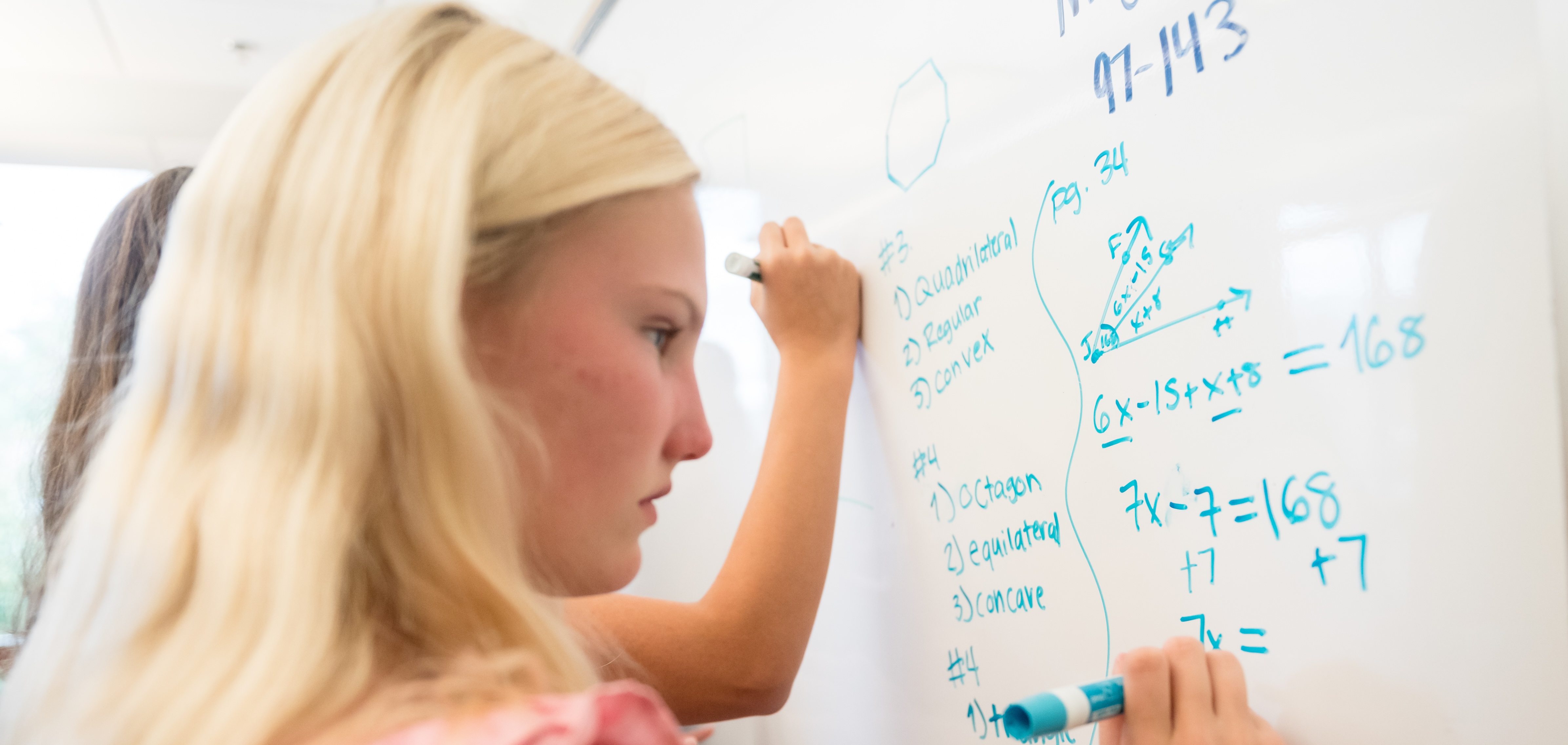
The Mathematics and Computer Science Department at Episcopal High School strives to offer each student both a challenge and an opportunity to succeed. Emphasis is placed on using applications of real world problems to provide a context for students not only to understand the traditional facts and techniques of mathematics, but also to develop the logical reasoning and problem-solving skills that will allow them to approach and solve unfamiliar problems throughout their lives. The Mathematics and Computer Science Department encourages students to pursue the study of mathematics throughout all four years of high school.
Graduation Requirement: 3 credits
A minimum of three credits and successful completion of any precalculus course is required in mathematics. A junior is required to take a full year of math and EHS strongly encourages students to take mathematics every semester during their time at Episcopal
Course Offerings Below
| Algebra (1.0 credit, full year) 9th, 10th |
|---|
| This course introduces students to the essential concepts of Algebra as they develop reasoning and problem-solving skills. Major topics will include solving equations, inequalities, and systems of equations; the fundamentals of exponents, radicals, and factoring; graphing and understanding linear and quadratic functions. This course will also emphasize the skills necessary to be successful in any math classroom, and it will align with the curriculum in Conceptual Physics to support and reinforce student learning. Students will be encouraged to develop the initiative necessary to work through challenging problems individually and cooperatively, making appropriate use of resources. |
| Geometry (1.0 credit, full year) 9th, 10th Prerequisite: Algebra 1 |
| Students will study Euclidean Geometry, emphasizing problem-solving, proofs, and graphing in the coordinate plane. Topics include properties of figures in two and three dimensions, similarity, congruence, area, and right triangle trigonometry. Students will work collaboratively and be expected to justify and explain their reasoning — especially in the context of two-column proofs — and use tools like the free-to-use Geogebra. Through the course will review many algebra topics, a strong foundation in solving and graphing linear equations is expected. Familiarity with the following topics is expected: solving single variable equations and systems of equations, graphing lines, identifying slopes, and y-intercepts. |
| Honors Geometry (1.0 credit, full year) 9th, 10th Prerequisite: Algebra 1, department approval |
| Students will study Euclidean Geometry with an emphasis on problem-solving, construction, proofs, and graphing in the coordinate plane. Topics include properties of figures in two and three dimensions, similarity, area, volume, and right triangle trigonometry. Students will frequently work collaboratively and be expected to justify and explain their reasoning using tools like a geometer's compass and the free-to-use graphing software GeoGebra. The course is heavily problem-based and designed to develop skills, conceptual understanding, and synthesis of content across topics. Students should be prepared to meet honors-level expectations of challenge and rigor, with homework requirements frequently reaching three hours per week. Familiarity with the following Algebra 1 topics is expected: solving systems of equations, graphing linear equations, ratios and proportions, irrational numbers, and solving quadratic equations by factoring. |
| Algebra 2 (1.0 credit, full year) 10th, 11th Prerequisite: Algebra 1, Geometry |
|
This course continues the study of algebra, reviews concepts seen in Algebra 1, and serves as a natural extension of the topics covered in Algebra 1. The course prepares students to complete Fundamentals of Precalculus successfully. Topics include proportions, factoring, solving equations and inequalities (including absolute values), solving linear systems with graphing, substitution, elimination, and linear programming. This course's major focus is solving linear and quadratic functions and equations, along with basic exponential and logarithmic functions and equations. A study of rational and radical functions will also be introduced. Familiarity with the following topics is expected: identifying & graphing linear equations, solving linear equations, identifying & solving basic systems of equations, solving inequalities, simplifying expressions, and using ratios & proportions. |
| Algebra 2/Trigonometry (1.0 credit, full year) 9th, 10th, 11th Prerequisite: Algebra 1, Geometry |
| Designed for students with one or more years of algebra and one full year of geometry, this course continues the study of algebra and reviews work with linear functions and systems. The course introduces various function families, including absolute value, quadratics, exponential, logarithmic, radical, and rational functions. The second semester of the course will introduce the fundamentals of trigonometry and will aim to prepare students for Precalculus. Familiarity with the following topics is expected: solving single variable and systems of equations, graphing linear equations, ratios, and proportions, solving quadratic equations by factoring, and solving right triangles using trigonometry. |
| Honors Algebra 2/Trigonometry (1.0 credit, full year) 9th, 10th, 11th Prerequisite: Algebra 1, Geometry, or Honors Geometry, department approval |
| This two-semester, highly accelerated discussion-based course covers a vast breadth of advanced algebra topics. The pace is demanding, and the dense problem sets that students will encounter will be challenging. For students who have completed a thorough study of Algebra I and Geometry, some topics will be familiar, though likely presented in novel contexts; other ideas and techniques will be new. This course is designed to prepare highly motivated students who are interested in striving for EHS' advanced offerings, including BC Calculus and higher levels. Familiarity with the following topics is expected: solving systems of equations, graphing linear equations, ratios, and proportions, and solving quadratic equations by factoring. Students should also have knowledge of functions and function notation and a basic understanding of trigonometry including: sine, cosine, and tangent. |
| Fundamentals of Precalculus (1.0 credit, full year) 11th, 12th Prerequisite: Algebra 2 |
|
This course begins with a review of linear functions and then moves on to the graphs and transformations of various functions (quadratic, rational, radical, and absolute value.) The course continues into a study of the basics of trigonometry. Emphasis is placed on equation solving, graphing, and reinforcing algebraic skills and concepts. Familiarity with the following topics is expected: solving systems of equations, graphing linear equations, ratios, and proportions, and solving quadratic equations by factoring. |
| Precalculus (1.0 credit, full year) 10th, 11th, 12th Prerequisite: Algebra 2/Trig |
|
This course is designed to bridge the connection from Algebra to Calculus. Topics and concepts learned in prior Algebra classes are reinforced, and new topics are introduced. The goal is to deepen mathematical understanding and the ability to synthesize concepts. Topics include functions (polynomial, rational, exponential, and logarithmic), and trigonometry (solving equations, graphing functions, and verifying identities). Familiarity with the following topics is expected: solving systems of equations, graphing linear equations, ratios, and proportions, solving quadratic equations by factoring, and a basic understanding of trigonometry including sine, cosine, and tangent. |
| Honors Precalculus (1.0 credit, full year) 9th, 10th, 11th Prerequisite: Algebra 2/Trig or Honors Algebra 2/Trig, department approval |
|---|
|
This course studies the real and complex number systems and analysis of functions (polynomial, rational, circular, trigonometric, exponential, logarithmic, and logistic). It introduces and reinforces the study of vectors in two and three dimensions, parametric functions, analytic geometry, and polar functions. The course introduces calculus through optimization, asymptotic behavior, and limits. Students are expected to apply skills and concepts learned in various novel and challenging ways throughout the course. Familiarity with the following topics is expected: solving systems of equations, graphing linear equations, ratios, and proportions, solving quadratic equations by factoring, and a basic understanding of trigonometry including sine, cosine, and tangent. |
| Introduction to Statistics and Applied Mathematics (1.0 credit, full year) 12th Prerequisite: Fundamentals of Precalculus or Precalculus |
| In the first semester, this elective course explores how to collect, display, interpret, and analyze statistical data. The semester centers around applying statistical methods to real-world issues with current data sets. In addition to traditional assessments, students will be expected to collaborate with their peers to design their own surveys, collect and analyze the results, and present their findings. The second semester will focus on applying statistical practices to practical applications such as financial literacy and data management. Students will explore financial decision-making, risk management, and investment vehicles through statistical analysis. |
| Calculus (1.0 credit, full year) 11th, 12th Prerequisite: Precalculus |
|
This course explores topics in differential calculus and simultaneously reinforces algebraic skills. Understanding and mastery of intermediate skills in algebra and precalculus are expected. Topics include limits, continuity, differential and introductory integral calculus and their applications, including problems in the area of physics, and the role of calculus as a tool for problem-solving is emphasized. This course is open to all students who have completed Precalculus or Honors Precalculus. Familiarity with the following topics is expected: solving quadratic equations by factoring, identifying parent functions & their properties, identifying & solving polynomial, logarithmic, exponential, rational, & radical equations, familiarity with basic trigonometry & physics. |
| Advanced Calculus AB (1.0 credit, full year) 10th, 11th, 12th Prerequisite: Precalculus or Honors Precalculus, department approval |
|
This course mirrors a college-level Calculus course that covers limit, differential, and integral calculus. A strong understanding of algebraic skills and Precalculus functions is expected and needed to find success. Students will need to apply skills and concepts learned in various ways. All topics in this course fall under the AP Calculus AB curriculum, though additional study and preparation are advised for those wishing to take the AP exam. Familiarity with the following topics is expected: solving quadratic equations by factoring, identifying parent functions & their properties, identifying & solving polynomial, logarithmic, exponential, rational, & radical equations, familiarity with basic trigonometry & physics. |
| Advanced Calculus BC (1.0 credit, full year) 10th, 11th, 12th Prerequisite: Honros Precalculus or department approval |
|
This course mirrors a college-level Calculus course that covers limit, differential, integral polar, parametric, and vector calculus, as well as sequences and series. This course has greater breadth, pace, and depth than AB Calculus. Students are expected to apply skills and concepts learned in various novel and challenging ways throughout the course. This course prepares students to take the AP Calculus BC Exam. Familiarity with the following topics is expected: solving quadratic equations by factoring, identifying parent functions & their properties, identifying & solving polynomial, logarithmic, exponential rational, & radical equations, familiarity with basic trigonometry & physics. |
| Advanced Multivariable/Vector Calculus (1.0 credit, full year) 11th, 12th Prerequisite: Advanced Calculus AB/BC, deparment approval |
|
An undergraduate-level exploration of topics in Multivariable Calculu, including multivariable functions, vectors and vector fields, differention and integration in multiple variables, line integrals, flux, curl, and Stokes' Theorem. Students should expect both traditional summative assessments and collaborative problem sets and projects. This course is designed for students who have completed single-variable Calculus and are excited to pursue challenging higher-level topics in mathematics. It is appropriate for students interested in majoring in math, engineering, or computer science. Familiarity with the following topics is expected: Derivative Calculus, Taylor series, and basic vector operations. |
| Advanced Linear Algebra (1.0 credit, full year) 11th, 12th Prerequisite: Advanced Calculus AB/BC, department approval |
|
An undergraduated-level exploration of topics in Linear Algebra, inclduing matrix Algebra, vector spaces, linear transformations, determinants, eigenvectors, and orthogonality. Students should expect both traditional summative assessments as well as collaborative problem sets and projects exploring applications in Calculus, statistics, probability, and computer science. Students will also develop rudimentary programming skills using MatLab. This course is designed for students who have completed single variable Calculus and are excited to pursue challenging higher level topics in mathematics. It is appropriate for students interested in majoring in math, engineering, or computer science. Familiarity with the following topics is expected: Derivative Calculus, integration, Taylor series, and basic vector operations. |
| Advanced Statistics (1.0 credit, full year) 10th, 11th, 12th Prerequisite: Honors Algebra 2, Precalculus, or Honors Precalculus, department approval |
| This course is an introduction to the major concepts of a college-level introductory course in statistics. Students will expected to select methods for collecting and/or analyzing data for statistical inference, describe patterns, trends, associations, and relationships in data, explore random phenomena using probability and simulation, and develop an explanation or justify a conclusion using evidence from data, definitions, or statistical inference. Units include one and two-variable statistics, collecting data, probability and sampling distributions, and statistical inference for categorial and quantitative data. This course prepares students to take the AP Statistics Exam. |
| AI: Skills and Ethics (0.5 credit, spring only) 12th |
|
How do you use AI well, how do you know when not to use it at all, and how will the answers to these questions change in the future? Will humans always be in charge? What differentiates humans from one another in a world where AI can do everything? In this senior-level course, students will learn the fundamentals of machine learning and artificial intelligence from a non-technical perspective. Students will develop skills in using AI, including and beyond large language models like ChatGPT. Along the way, students will learn how these machines actually work, from Markov chains to neural networks to the research shaping AI's future. The class will culminate in a large-scale independent project in which students—and their tools—will have complete control. |
| Computer Science and Data Analytics (0.5 credit, spring only) 10th, 11th, 12th Prerequisite: Algebra 2/Trig |
|
Blending mathematics, statistics, and computer programming, this course provides an introduction to computer science and the emerging field of data science. Students will analyze large sets of data from areas such as the financial sector, retail sales, sports analytics, healthcare industry, and social networking platforms looking for patterns and trends. Using the open-source computer language R, students will identify regularities within a data set, exposing secrets and making original discoveries. Sample projects include gathering vast amounts of data about consumers to predict shopping habits and analyzing sports statistics to evaluate an athlete's value and performance. |
| Advanced 3D Modeling, Computer Aided Design & Manufacturing (0.5 credit, fall only) 10th, 11th, 12th Corequisite: Precalculus |
|
Coursework will cover introductory and advanced 3D modeling, introduction to simulation, manufacturing design principles, and project management. This course uses the open-source modeling software Autodesk Fusion 360 to create multifaceted designs. Students will explore real-world applications to devise models from an initial design to a final physical product. The projects will guide students through an exploration of computer science, mathematics, science, and engineering. Sample projects include developing mechanical components, creating full-scale blueprints of a modular house, and analyzing production output data to optimize efficiency. In addition, students will be given opportunities to gain skills and knowledge needed in the product development and manufacutring industry. |
| Advanced Computer Science (1.0 credit, full year) 10th, 11th, 12th Prerequisite: Algebra 2/Trig, department approval |
| This course introduces students to the foundational topics of computer science such as design strategies, data structures, algorithms, and logic-based decision making. Students will learn the fundamentals of the Java programming language and will use programming tools to solve complex problems through hands-on experiences and examples. This course is meant to be the equivalent of a first-semester college course in computer science, and prepares students to take the AP Exam. |
| Advanced Computer Science: Data Structures, Algorithms, and Computer Architecture (1.0 credit, full year) Prerequisite: Advanced Computer Science, department approval |
| This course is a college-level continuation of Advanced Computer Science for students who succeed in the Advanced Computer Science course and remain interested in the subject. The course is designed to improve students' skills as coders and algorithmic thinkers. The first semester of the course uses the Java language and explores common ways that computer scientists store and access data, the trade offs between these data structures, and how different data structures can be used to solve specific problems in the real world. Students will learn to code famous algorithms like Dijkstra's, Kruskal's, and the binary search, and they will write their own fully-functioning hash table. The second semester is a deep dive into the design of computers, during which students will learn exactly how a computer works internally, and how combinations of ones and zeros produce everything we know about technology today. It's not magic! |