
Global Online Academy
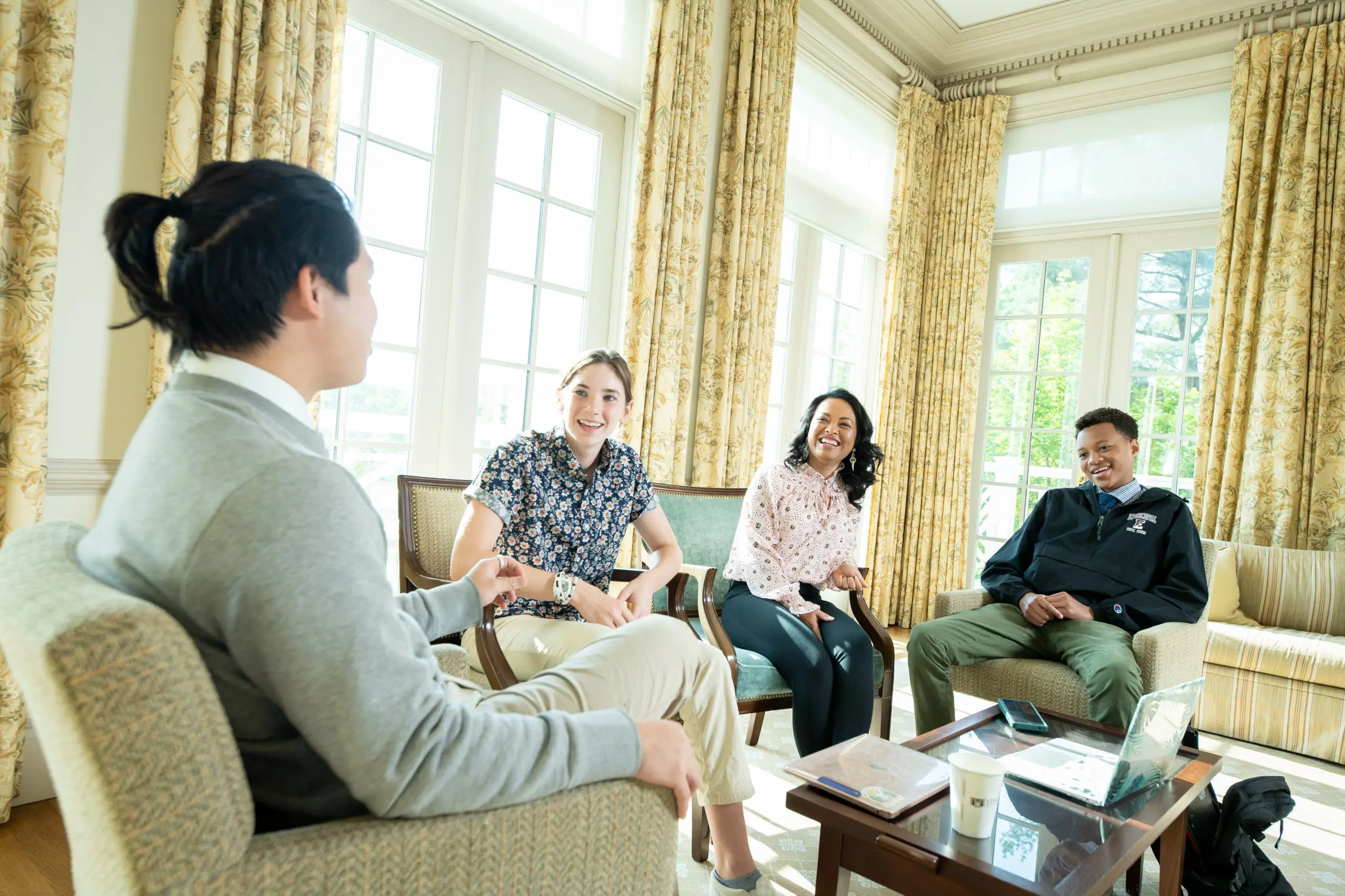
Global Online Academy (GOA) offers Episcopal students the chance to learn in a highly collaborative, global, online learning community. GOA courses are led by expert teachers and students connect with peers from across the world in flexible, independent, and primarily asynchronous coursework. Students may take a GOA course with the permission of the Assistant Head for Academics and the GOA Site Director. Students should be enrolled in at least five academic courses on campus in addition to their GOA course. Families are responsible for payment for any elective GOA course.
For additional information about enrolling in a GOA course, please contact Episcopal's GOA Site Director, Dr. Kimberly Olsen (goa@episcopalhighschool.org)
Course Offerings Below
English
| GOA: Creative Nonfiction Writing (0.5 credit, summer only) |
|---|
|
Are you a storyteller at heart? In this course, you'll learn how to transform real experiences into captivating narratives, all while strengthening core writing skills. You'll explore diverse forms of creative nonfiction — personal narratives, opinion pieces, profiles, and more. Along the way, you'll create a library of inspiring texts, consider publishing opportunities, and establish sustainable writing habits. Connect with a global community through video chats and online discussions, where you'll participate in a supportive workshop model, receive valuable feedback, and grow as a writer in today's exciting nonfiction genre. This fulfills the writing requirement. |
Mathematics and Computer Science
| GOA: Algebra II (1.0 credit, summer only) Prerequisite: Algebra 1, Geometry |
|---|
|
This accelerated seven-week Algebra II summer course condenses a full year of course material into an intensive, 7-week learning experience. Building on the foundations of Algebra I, you'll strengthen your fluency with equations, inequalities, and functions while exploring quadratics, polynomials, rational expressions, exponentials, and logarithms. Expect to dedicate 15-20 hours per week as you connect algebraic, graphical, and numerical representations to deepen conceptual understanding and apply your skills to real-world problem-solving. Through guided exploration and challenging applications, you'll learn how different types of functions model real situations, analyzing characteristics such as domain, range, intercepts, asymptotes, and end behavior. Core topics include factoring and operations with polynomials, solving quadratic and higher-order equations, simplifying radicals and complex numbers, and applying exponential and logarithmic properties. Departmental permission required in advance of registering for course. |
| GOA: Computer Science I: Conceptual Thinking (0.5 credit, fall, spring, or summer) Prerequisite: Honors Geometry, Algebra 2 |
| Computational thinking centers on solving problems, designing systems, and understanding human behavior. It has applications not only in computer science but also myriad other fields of study. This introductory-level course focuses on thinking like a computer scientist, especially understanding how computer scientists define and solve problems. Students begin the course by developing an understanding of what computer science is, how it can be used by people who are not programmers, and why it's a useful skill for all people to cultivate. Within this context, students are exposed to the power and limits of computational thinking. Students are introduced to entry-level programming constructs that help them apply their knowledge of computational thinking in practical ways. They learn how to read code and pseudocode as well as begin to develop strategies for debugging programs. By developing computational thinking and programming skills, students will have the core knowledge to define and solve problems in future computer science courses. While this course would be beneficial for any student without formal training as a programmer or computer scientist, it is intended for those with no programming experience. |
| GOA: Cybersecurity (0.5 credit, fall or spring) |
|
Safeguard the Digital World: Cybercrime is on the rise, and this is your chance to be part of the solution. Go beyond the basics of cybersecurity, as you explore the inner workings of computer components, network design, DNS, TCP/IP, and how cybercriminals exploit both technology and human behavior to breach systems. Examine ciphers, encryption, data security, and malware anatomy, while also considering the complex balance between privacy and tracking. You'll emerge with the expertise to defend both personal and organizational data, equipped with knowledge in data recovery, enterprise security, and the latest trends in cybersecurity. |
| GOA: Game Theory (0.5 credit, fall or spring) |
|
In this course, students explore a branch of mathematics known as game theory, which uses mathematical models to inform decision making. There are many applications to everyday dilemmas and conflicts, many of which can be treated as mathematical games. Students consider significant global events from fields like diplomacy, political science, anthropology, philosophy, economics, and popular culture. They examine models of world conflicts and scheduling of professional athletic contests. Specific topics include two-person zero-sum games, two-person non-zero sum games, sequential games, multiplayer games, linear optimization, and voting theory. |
| GOA: Geometry (1.0 credit, summer only) |
|
This seven-week summer course provides a fast-paced journey through a full year's worth of high school geometry. With a focus on Euclidean geometry, you'll explore key concepts like parallel lines, triangle congruence and similarity, quadrilaterals, polygons, and circles. Get ready to analyze lengths, areas, and volumes of both two-and-three-dimensional figures, while also tackling transformations and introductory trigonometry. With an intensive schedule (expect to dedicate 15-20 hours a week), you'll be well-prepared for future advanced math courses. Departmental permission required in advance of registering for course. |
| GOA: Number Theory (0.5 credit, fall only) Prerequisite: A strong background in Precalculus and above as well as a desire to do rigorous mathematics and proofs |
|
Once considered the most abstract and least practical area of mathematics, number theory is now essential to our everyday digital world: every second, millions of secure internet transmissions rely on number theory for encryption. In this course, you'll explore the world of mathematical reasoning and proof, learning the tools needed to understand the RSA algorithm — the backbone of global internet security. You'll also invent your own encryption schemes and encounter games that use number theory. Alongside practical applications, you'll get a taste of the rich history of this subject, from legendary mathematicians to the proof of Fermat's Last Theorem (a famous problem solved just 20 years ago after 350 years of effort). |
| GOA: Precalculus (1.0 credit, summer only) |
|
This seven-week summer course will take you on a fast-paced journey through a full year of high school precalculus. With a focus on functions — transformations, domain and range, and visual representations — you'll also deepen your understanding of equivalence across numerical, graphical, and algebraic forms while mastering algebraic manipulation. You'll apply existing skills to new situations as you tackle projects involving polynomials, matrices, trigonometry, sequences, and series while analyzing situations, creating models, and developing solutions. The experience culminates in a final project where you'll apply everything you've learned to explore and present a complex scenario. Departmental permission required in advance of registering for course. |
Modern and Classical Languages
| GOA: Arabic Language Through Culture I (Levels II and III also offered) (1.0 credit, full year) |
|---|
|
In addition to bringing Arabic popular culture to life, this course introduces students to the Arabic writing system to communicate in spontaneous spoken conversations on everyday topics. This year-long course focuses on Modern Standard Arabic (MSA) and some of the spoken dialects of the Levant, Egypt, and North Africa. With an emphasis on Arabic culture, students will learn commonly used expressions and phrases to develop their skills in listening, reading, writing, and most importantly, conversation. This will be accomplished through synchronous and asynchronous assignments, conversation sessions with the instructor and a group of peers, instructional videos, discussions about culture, and collaborations on group projects with students from around the globe. Since Arabic is becoming one of the most functional languages in the world, especially in the areas of commerce, business, and trade, students participating in this course can avail themselves of the opportunity to learn the language in a highly stimulating and rich cultural context. |
| GOA: Japanese Language Through Culture I (Levels II and III also offered) (1.0 credit, full year) |
|
This full-year course is a unique combination of Japanese culture and language, weaving cultural comparison with the study of basic Japanese language and grammar. While examining various cultural topics such as literature, art, lifestyle and economy, students will learn the basics of the Japanese writing system (Hiragana and Katakana), grammar and vocabulary. Through varied synchronous and asynchronous assignments, including hands-on projects and face-to-face communications, students will develop their speaking, listening, reading and writing skills. The cultural study and discussion are conducted in English, with topics alternating every two to three weeks. The ultimate goal of this course is to raise awareness and appreciation of different cultures through learning the basics of the Japanese language. The focus of this course is 60 percent on language and 40 percent on culture. This course is appropriate for beginner-level students. |
Science
| GOA: Abnormal Psychology (0.5 credit, fall, spring, or summer) |
|---|
|
Discover the Complexities of the Human Mind: Ever wondered why society views certain behaviors "abnormal"? As you learn about Western abnormal psychology, you'll explore the complex forces behind human behavior by studying conditions like anxiety, depression, eating disorders, and schizophrenia. Through engaging readings, videos, thought-provoking discussions, and a student-led project centered on your local community, you'll dive into the symptoms, diagnoses, and responses to these disorders. You'll also examine how mental health is influenced by cultural differences and global perspectives, gaining insight into the stigma surrounding psychological disorders. |
| GOA: Anatomy & Physiology (0.5 credit, fall only) |
|
Have you ever wondered how your heart keeps beating, how your lungs absorb oxygen, or how your brain sends signals that allow you to move and think? In this course, you'll explore the body's major systems — skeletal, muscular, nervous, cardiovascular, respiratory, digestive, urinary, and reproductive — and discover how they work together to sustain life and health. Along the way, you'll connect your learning to real-world health issues such as sports injuries, asthma, strokes, and diabetes. |
| GOA: Global Health (0.5 credit, fall only) |
|
What makes people sick? What social and political factors lead to the health disparities we see both within our own community and on a global scale? What are the biggest challenges in global health and how might they be met? Using an interdisciplinary approach to address these two questions, this course improves students' health literacy through an examination of the most significant public-health challenges facing today's global population. Topics include the biology of infectious disease, the statistics and quantitative measures associated with health issues, the social determinants of health, and the role of organizations (public and private) in shaping the landscape of global health policy. Students use illness as a lens through which to examine social issues like poverty, gender, and race. Student work includes analytical writing, research, readings and discussion exploring a variety of sources, and online presentations, created both on their own and with peers. |
| GOA: Medical Problem Solving I (0.5 credit, fall, spring, or summer) |
|
In this course, students collaboratively solve medical mystery cases, similar to the approach used in many medical schools. Students enhance their critical thinking skills as they examine data, draw conclusions, diagnose, and identify appropriate treatment for patients. Students use problem-solving techniques in order to understand and appreciate relevant medical/biological facts as they confront the principles and practices of medicine. Students explore anatomy and physiology pertaining to medical scenarios and gain an understanding of the disease process, demographics of disease, and pharmacology. Additional learning experiences include studying current issues in health and medicine, interviewing a patient, and creating a new mystery case. |
| GOA: Medical Problem Solving II (0.5 credit, fall or spring) Prerequisite: Medical Problem Solving I |
|
This course is an extension of the problem-based approach in Medical Problem Solving I. While collaborative examination of medical case studies remain at the center of the course, MPS II approaches medical cases through the perspectives of global medicine, medical ethics, and social justice. The course examines cases not only from around the worl but also in students' local communities. Additionally, the course addresses the challenges patients face because of a lack of access to health care, often a result of systemic discrimination and inequity along with more general variability of health care resources in different parts of the world. All students in MPS II participate in the Catalyst Conference, a GOA-wide conference near the end of the semester where students from many GOA courses create and publish presentations on course-specific topics. For their projects, students use all of the lenses from the earlier parts of the course to choose and research a local topic of high interest. Further, their topics enable identifying a local medical problem, using local sources, and generating ideas for promoting change. |
| GOA: Positive Psychology (0.5 credit, fall only) |
|
What is a meaningful, happy, and fulfilling life? The focus of psychology has long been the study of human suffering, diagnosis, and pathology, but in recent years, positive psychologists have explored what's missing from the mental health equation, taking up research on topics such as love, creativity, humor, and mindfulness. We dive into what research tells us about the formula for a meaningful life, the ingredients of fulfilling relationships, and changes that occur in the brain when inspired by music, visual art, physical activity, and more. We also seek out and lean on knowledge from positive psychology experts, such as Martin Seligman's well being theory, Mihaly Csikszentmihalyi's idea of flow, and Angela Lee Duckworth's concept of grit. Students imagine and create real-world measurements using themselves and willing peers and family members as research subjects. As part of the learning studio format of the course, students imagine, research, and create projects that they will share with a larger community. Throughout the development of these projects, students will collaborate with each other and seek ways to make their work experiential and hands-on. |
| GOA: Social Psychology (0.5 credit, fall or spring) |
|
Are you thinking and acting freely of your own accord or is what you think, feel, and do a result of influences by the people around you? Social psychology is the scientific study of how and why the actual, imagined, or implied presence of others influences our thoughts, feelings, and behavior. The principles of social psychology help explain everything from why we stop at stop signs when there is no one around to why we buy certain products, why in some situations we help others and in some we don't, and what leads to more dramatic (and catastrophic) events such as mass suicides or extreme prejudice and discrimination. As we take up these topics and questions, students will build and engage in a community of inquiry, aimed primarily at learning how to analyze human behavior through the lens of a social psychologist. Social Psychology invites students to explore, plan, investigate, experiment, and apply concepts of prejudice, persuasion, conformity, altruism, relationships and groups, and the self that bring the "social" to psychology. The course culminates in a public core competencies that transcend the discipline and learn how to think like a social psychologist. Much of the course is self-paced; throughout the semester, students are assessed primarily in relation to outcomes tied to the competencies. |
Social Studies
| GOA: Genocide & Human Rights (0.5 credit, fall only) |
|---|
|
Learn From the Past to Protect the Future: Why does genocide happen, and how can societies prevent it? In this course, you'll explore some of the most significant tragedies of the 20th century, including the Holocaust and the Armenian, Cambodian, and Rwandan genocides. You'll analyze the role of the international community in responding to and preventing further genocide, with a focus on the Nuremberg Tribunals, as well as investigate ongoing human rights crises around the globe. Through engaging discussions, brief papers, and documentaries, you will gain a deeper understanding of global issues related to justice and humanity. |
| GOA: Introduction to Blockchain & Cryptocurrency (0.5 credit, spring only) |
|
This beginner-friendly course dives into the fascinating world of blockchain and cryptocurrency, exploring how we got here and where the technology might be heading. You'll learn how crypto markets work, examine real-world applications, and consider the potential future of crypto through the perspectives of creators, consumers, and governments. Plus, you'll explore blockchain's far-reaching potential to revolutionize government, business, the arts, and more. Why take this course? Through engaging technologies, activities, and collaborative projects, you'll analyze how blockchain and cryptocurrency disrupt and shape various industries, preparing you to navigate and contribute to this transformative field. |
| GOA: Investing I (0.5 credit, fall, spring, or summer) |
|
In this course, students simulate the work of investors by working with the tools, theories, and decision-making practices that define smart investment. We explore concepts in finance and apply them to investment decisions in three primary contexts: portfolio management, venture capital, and social investing. After an introduction to theories about valuation and risk management, students simulate scenarios in which they must make decisions to grow an investment portfolio. They manage investments in stocks, bonds, and options to learn a range of strategies for increasing the value of their portfolios. In the second unit, students take the perspective of venture capital investors, analyzing startup companies and predicting their value before they become public. In the third unit, students examine case studies of investment funds that apply the tools of finance to power social change. Throughout the course, students learn from experts who have experience in identifying value and managing risk in global markets. They develop their own ideas about methods for taking calculated financial risks and leave this course not just with a simulated portfolio of investments, but the skills necessary to manage portfolios in the future. |
| GOA: Investing II (0.5 credit, fall or spring) Prerequisite: Investing I |
|
In this course, students expand their knowledge of practices that define smart investment. They explore concepts in finance and apply them to investment decisions in four primary contexts: fixed-income investments, foreign exchange and crypto, commodities, and real estate. After an introduction to theories about behavioral finance, students simulate scenarios in which they must make decisions to add to their portfolio of equities. In the first unit, they learn how fixed-income assets like bonds fit into a larger portfolio to hedge risk in their community of vehicle preal-lifeortfolios. In the second unit, students examine forex trading and the cryptocurrency markets, a riskier and more volatile investment vehicle. In the third unit, students examine how commodities can be a part of a larger portfolio, but also how commodity prices might affect the larger economy. Finally, in the fourth unit, students learn about the array of strategies in real estate investing. Throughout the course, students learn from experts who have experience in identifying value and managing risk in global markets. They develop their own ideas about methods for taking calculated financial risks and build on their understanding from Investing I. They leave this course with a more nuanced view of their overall portfolio and the skills necessary to manage risk in the future. |
| GOA: Personal Finance (0.5 credit, summer only) |
|
In this course, students learn financial responsibility and social consciousness. We will examine a wide array of topics including personal budgeting, credit cards and credit scores, career and earning potential, insurance, real estate, financial investment, retirement savings, charitable giving, taxes, and other items related to personal finance. Students will apply their understanding of these topics by simulating real-life financial circumstances and weighing the costs and benefits of their decisions. Throughout the course, students will have the opportunity to learn from individuals with varying perspectives and expertise in numerous fields. By reflecting on their roles in the broader economy as both producers and consumers, students will begin to consider how they can positively impact the world around them through their financial decisions. |
| GOA: Perspectives on Gender & Culture (0.5 credit, spring only) |
|
Explore Identity Across Cultures and Time: How does gender shape the world around us? This dynamic course uses the concept of gender to explore a wide range of current topics, from feminism and LGBTQ+ studies to popular culture and politics. You'll investigate how gender intersects with other social identifiers like class, race, sexual orientation, culture, and ethnicity. Through engaging readings, thoughtful writing, and lively discussions, you'll analyze gender issues and reflect on how they have shaped both your experiences and those of your global peers. |
| GOA: Race, Culture & Community (0.5 credit, fall only) |
|
Explore the Dynamics of Social Construct: What is race? Is it something we're born with, or is it an idea created by society? Is it an identity we perform? A privilege for some? And how do the ways people understand race vary around the world? In this course, you'll dive into these essential questions, examining race as a social construct that has a profound impact on societies and cultures. Through thought-provoking readings, films, and guest speakers from fields like history, sociology, anthropology, and literature, you'll research, reflect on, and discuss the intricate dynamics of race and society across different times and places. |