Science
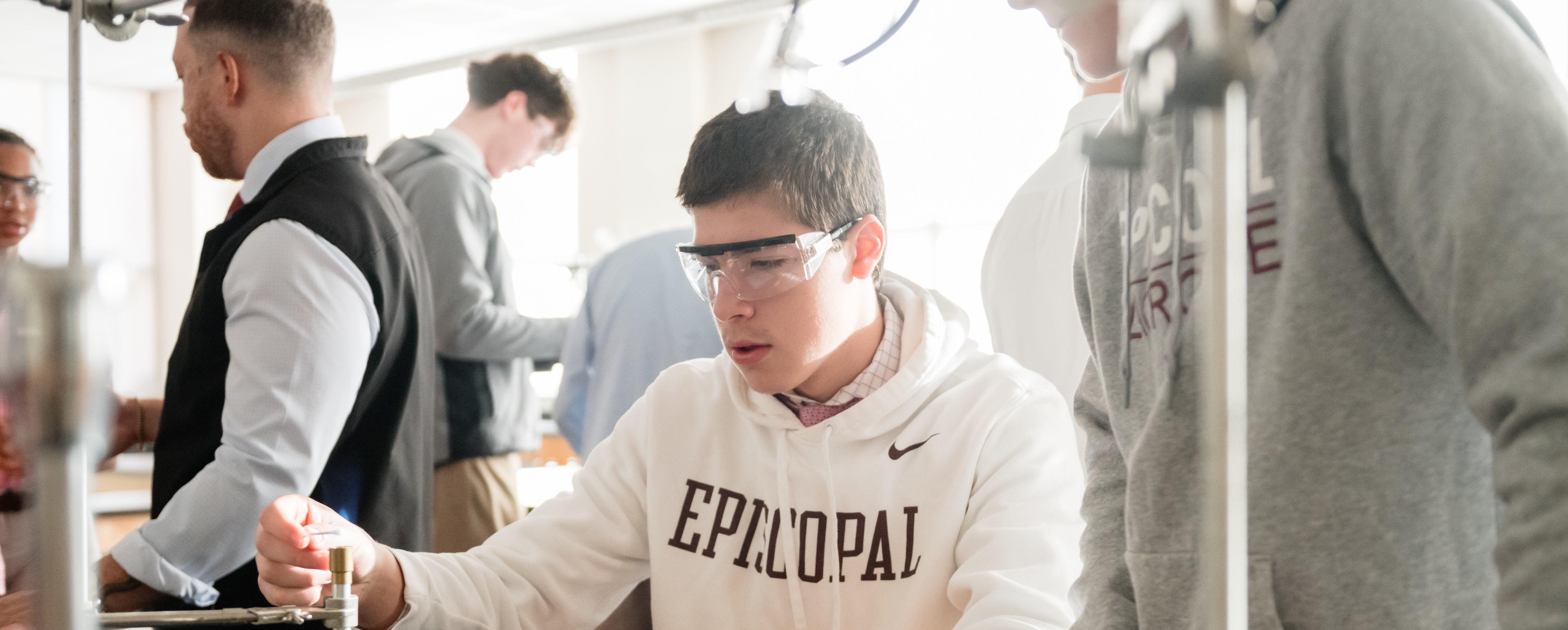
Episcopal believes that a comprehensive understanding of the scientific process is essential for informed decision-making and responsible citizenship in an increasingly complex and technical world. The science curriculum is designed to build a strong foundation in the core scientific disciplines, with students introduced to physics in the ninth grade, followed by chemistry in the tenth grade, and biology in the eleventh grade. Teachers integrate interdisciplinary skills, concepts, and real-world problems into their instruction to promote scientific literacy. Students are expected to apply knowledge from prior courses to deepen their understanding in subsequent classes. Laboratory work is not merely a supplement but an integral component of each course, fostering hands-on learning and scientific inquiry.
Graduation Requirement: 2 credits
Students are required to earn at least two credits in laboratory science (Physics, Chemistry, Biology), the last of which must be earned at EHS. Episcopal strongly encourages students to take more than two lab science credits, as many colleges expect students to have three or four science credits.
Course Offerings Below
| Conceptual Physics (1.0 credit, full year) 9th Corequisite: Algebra 1 |
|---|
| Designed for students co-enrolled in Algebra 1, this course emphasizes a conceptual understanding of physics. The first semester introduces waves, sound, and light before progressing to mechanics. Mathematical problem-solving is introduced at an appropriate level, and the course curriculum is aligned to support and reinforce lessons learned in Algebra 1. Students engage in frequent hands-on activities, experiments, and demonstrations to connect principles to everyday experiences. Only students concurrently enrolled in Algebra 1 are eligible to take Conceptual Physics. |
| Physics (1.0 credit, full year) 9th |
| This introductory course emphasizes fundamental physics principles and their real-world applications. The first semester focuses on mechanics, while the second semester explores electricity, waves, sound, and light. Class time includes hands-on activities, collaborative group work, and both qualitative and quantitative laboratory experiments. Demonstrations and problem-solving exercises reinforce key concepts and develop students' analytical skills. |
| Intermediate Physics (1.0 credit, full year) 11th, 12th |
| This course is a survey of many topics that comprise the study of Physics: measurement, experimental design, data collection and analysis, mechanics, energy, sound, electricity, magnetism, and light. The presentation is complemented by a mathematical component at an appropriate level supported by demonstrations and hands-on lab, study, and projects. The goal is to connect principles with everyday experiences. |
| Advanced Physics 1 (1.0 credit, full year) 11th, 12th Prerequisite: Completion of Honors Algebra 2 Trig or Precalculus or higher math course or co-enrolled in Honors Precalculus or higher. Expectations in this course include a grade of 95 in their previous regular science course or evidence of success in honors- or advanced-level science courses, active participation in class, and demonstrated ability to work independently and with others in a variety of classroom situations. Department approval. |
| This course serves as a physics survey and as a proper introduction for those who may go on to further technical studies in college. The course covers many of the same areas as an introductory physics course focusing on mechanics, however the approach is more analytical and makes free use of algebra and trigonometry. The class prepares students to take the AP Physics 1 exam. Frequent laboratory experiments are an important component of the class. |
| Advanced Physics C (1.0 credit, full year) 11th, 12th Corequisite: Calculus or higher math course. Expectations in this course include a grade of 95 in their previous regular science course or evidence of success in honors or advanced-level science courses, active participation in class, and demonstrated ability to work with others in a variety of classroom situations. Department approval. |
| This is a college-level course for those who are considering majoring in science or engineering. The class focuses on classical mechanics and prepares students to take the AP Physics C Mechanics exam. Calculus is used in problem-solving. Frequent laboratory experiments are an important component of the class. |
| Chemistry Fundamentals (1.0 credit, full year) 10th |
|
This course builds a strong foundation in chemistry through engaging projects and investigative labs. Students explore atomic structure, the periodic table, bonding, and chemical reactions while developing problem-solving skills through inquiry and collaboration. Labs incorporate modern techniques like temperature and pH sensors, titration, modeling, and graphing. Structured lab reports strengthen data analysis and communication skills. While fostering a deep conceptual understanding of introductory chemistry, please note, this course does not fulfill the prerequisite for Advanced Chemistry. |
| Honors Chemistry (1.0 credit, full year) 10th Prerequisite: 95 or above in the full year of the previous science course, active participation in class, and demonstrated ability to work with others in a variety of classroom situations. Corequisite: Honors Algebra 2, Trigonometry or higher math course. Department approval. |
|
Honors Chemistry is an accelerated, comprehensive high school chemistry course. The Honors class requires significant independent effort and moves more quickly through the foundations of chemistry to allow more time for advanced topics and labs. This course places emphasis on fundamental concepts, such as principles of chemical reactions and chemical bonding, as well as the application of these principles to descriptive chemistry. Experiments play an integral part in the course and help students discover basic principles for themselves. Topics include atomic theory, the periodic table, bonding, formulas, reactions, solutions, acids, bases, stoichiometry, and an introduction to equilibrium. Students are required to have strong math skills and a solid foundation in the physical sciences. |
| Advanced Chemistry (1.0 credit, full year) 11th, 12th Prerequisite: 90 or above in the full year of Honors Chemistry or by department permission. Corequisite: Honors Algebra 2 Trigonometry or higher math course. Expectations in this course include active participation in class and demonstrated ability to work with others in a variety of classroom situations. Department approval. |
|---|
|
This course is the equivalent of an introductory college-level chemistry course. Students who successfully complete this course should be well prepared to take the AP Chemistry exam in May. In this class we reinforce the chemical principles learned in introductory Honors-level chemistry courses including periodic properties of elements, chemical formulas and equations, states of matter, stoichiometry, and chemical bonding. Students in this course will also include new quantitative topics such as chemical kinetics, chemical equilibrium, and thermodynamics. The goal is for students to attain an in-depth understanding of fundamental concepts and to develop competence in dealing with general chemistry problems. |
| Biology (1.0 credit, full year) 11th, 12th Prerequisite: Chemistry |
| Biology introduces students to the fundamentals of the study of life. It encompasses essential concepts needed to explain our natural world and their interdependence with the environment. The course covers, but is not limited to: cells, biochemistry, genetics, biotechnology, evolution, ecology and human biology. Students focus on the study of biological processes, structures and functions at multiple levels of organization. They explore patterns, processes, and systems in order to understand the fundamental principles of living organisms. The course strengthens the development of analytical science skills, critical thinking, problem-solving and the practical application of technology and use of scientific tools. Students are active learners. They collect, analyze and interpret data working both independently and collaboratively in the classroom and laboratory. The ultimate goal is for students to have a deeper understanding of the world through an examination of the underlying processes and mechanisms of life. |
| Advanced Biology (1.0 credit, full year) 11th, 12th Prerequisite: Chemistry. Expectations in this course include a grade of 95 in their previous regular science course or evidence of success in honors- or advanced-level science courses, active participation in class, and demonstrated ability to work with others in a variety of classroom situations. Department approval. |
|
This course is the equivalent of an introductory college-level course. Core material includes fundamental principles of biochemistry, genetics, molecular biology, cell biology, and organismal biology. These topics will address the structure and regulation of proteins, how such molecules are integrated into cells, the role of genes, the internal regulation of body systems, and the interactions of organisms. Special topics may include cancer biology, infectious diseases, and neurobiology. Students will be challenged to apply their understanding in search of the "why". Laboratory work will support the major themes of the curriculum, including modern genetic techniques and biotechnology. Other integral aspects to the course are attention to current scientific literature, project-based learning, hands-on activities, and student-led seminars. |
| Advanced Energy, Climate, and Sustainable Actions (0.5 credit, fall or spring) 11th, 12th Prerequisite: A grade of 95 in previous regular science course or evidence of success in honors or advanced-level science courses, active participation in class, and demonstrated ability to work with others in a variety of classroom situations. Department approval. |
|
This course will examine the topics surrounding energy production, climate change and sustainability. It will explore both the science of climate change and the human-related causes of climate change with a focus on how the need for energy drives greenhouse gas emissions. The course will also examine different ways in which governments and organizations can respond to climate change both in terms of mitigation and adaptation, with a focus on sustainable practices. Current events, lab activities and off-campus experiences will guide learning with a goal of students presenting sustainable action plans for either the school community or their local community. |
| Advanced Environmental Science (1.0 credit, full year) 12th Prerequisite: Chemistry and Biology. Expectations in this course include a grade of 95 in their previous regular science course or evidence of success in honors- or advanced-level science courses, active participation in class, and demonstrated ability to work with others in a variety of classroom situations. Department approval. |
|
This course delves into the intricacies of the natural world and its complex interrelationships, with a focus on evaluating human impact on the environment. Utilizing both regional and global ecosystems as examples, students will be introduced to the scientific concepts and principles necessary to comprehend the relationships between abiotic and biotic components. Students will combine hands-on fieldwork and ArcGIS software to create and analyze maps to illustrate the impact of abiotic components on the living world. This program emphasizes the use of data for projecting the effects of environmental changes, and involves the collection and interpretation of longitudinal data from a pond and watershed. Assessments include tests, quizzes, projects, presentations, map production, participation in class discussions, lab reports, and lab tests. |
| Advanced Engineering (0.5 credit, spring only) 12th Prerequisite: Physics, and corequisite: Advanced Calculus. Expectations in this course include a grade of 95 in their previous regular science course or evidence of success in honors- or advanced-level science courses, active participation in class, and demonstrated ability to work with others in a variety of classroom situations. Department approval. |
|
This course utilizes previously learned science and higher-level mathematics to investigate several facets of problem-solving aspects in engineering. In addition to the hands-on emphasis of the course, it exposes students to software that is specific to engineering areas such as analog and digital input, structural design modeling, control systems, and programming. Other topics may include material properties, fluid dynamics, fuel cells, work design and ergonomics, operations models and production planning. |
| Advanced Science Journalism: Reading & Writing (0.5 credit, fall only) 11th, 12th Prerequisite: Department approval |
|
This elective course will explore the art and craft of writing about science for academic and general audiences. Students will learn strategies for reading and summarizing scientific papers as well as designing visual abstracts to explore the responsible use of data. Using these skills, students will write about science for general audiences, identifying ways to find the interesting news angles in recently-published scientific research, and writing explanatory prose that combines clear presentation with creative style and the use of storytelling. This course will also explore long-form science writing, reading excerpts from books by Rachel Carson, Michio Kaku, Chanda Prescod-Weinstein, Rebecca Skloot, Ed Young, Carl Zimmer, and Cat Bohannon. As the course progresses, students will be encouraged to choose a science "beat" and produce a portfolio of work characterized by their own distinctive voice and style. This course also fulfills a semester English credit. |
| Astronomy (0.5 credit, fall only) 11th, 12th |
| In this elective course, students will explore celestial objects, space, and the physical universe. The focus will be on star formation and stellar evolution, with special emphasis on our sun and how it compares to other stars. Through data analysis and scientific inquiry, students will investigate stellar properties, life cycles, and the fundamental forces shaping the cosmos. Hands-on activities and observational studies will enhance their understanding of astronomical phenomena. |
| Botany (0.5 credit, fall or spring) 11th, 12th |
|
This elective course focuses on hands-on project work in the field and lab, to introduce students to visual plant identification. Students learn to use leaf shapes, branching patterns, and the parts of flowers to identify plants. Students learn botanical terms through lab work and fieldwork in the EHS Greenhouse, the campus gardens, Laird Acres, and beyond. |
| Engineering (0.5 credit, fall only) 11th, 12th Prerequisite: Physics, and corequisite: Precalculus. |
|
This course utilizes previously learned science, principles with practical engineering applications. The course is hands-on with emphasis on student projects that incorporate data collection and processing, design drawings and modeling, and spreadsheet analysis. Topics may include roller coasters, robotics and programming, structural engineering, material properties, batteries and fuel cells, and optical instrumentation. |
| Ethics: Science and Society (0.5 credit, spring only) 11th, 12th |
|
This elective course will explore the role of ethics in socioscientific contexts. First, students will examine ethics and science as systems of thought and action, distinguishing normative ethical perspectives (deontology, utilitarianism, and virtue ethics) and exploring how trustworthy science depends on adherence to an ethical framework. With this foundation, students will analyze the role of ethics in several socioscientific contexts, including: university-level scientific research; medical practice; the use of genetic technologies; global problems (e.g. pandemics and vaccination, plastic innovations/waste, climate change), and advancing technologies (e.g. AI, space exploration). This course may be taken for dual credit to fulfill a science elective and the senior theology elective. |
| Evolutionary Biology and Immunology (0.5 credit, spring only) 11th, 12th Corequisite: Biology |
| In this elective course, students will investigage the evolutionary foundation of illness. By connecting principles of evolution, ecology, genetics, and our immune system; students will understand why humans get sick. Through lab work, critical thinking exercises, and group discussions, students will explore why certain diseases persist, how our immune system adapts, and what factors contribute to individual differences in disease resistence. By the end of the course, students will gain a deeper understanding of how the same evolutionary forces that drive human adaptation also influences our vulnerability to illness. |
| Neuroscience (0.5 credit, fall only) 11th, 12th Corequisite: Biology |
| In this elective course, students will examine how the internal and external environments influence the brain to shape perception, regulate body functions, and drive behavior. To assist with this examination, the course will cover fundamental principles of brain architecture, including key structures, neural pathways, and neurotransmitters. Through research, case studies, labs, and data analysis, students will examine the biological foundations of identity, gaining insight into the factors that make each individual unique. |
| Psychology (0.5 credit, fall or spring) 11th, 12th |
| This elective course provides an introduction to the scientific study of behavior and mental processes. The course surveys several of the major sub-disciplines of the field, including units on neuroscience, methodology and ethics of psychological research, learning and memory. Lessons, activities, and readings emphasize the scientific underpinnings of the prevailing theories and their applications and encourage an understanding of the student's world and experiences through this scientific lens. |
| Robotics, Engineering, and Programming (0.5 credit, spring only) 11th, 12th |
| This one-semster elective class introduces students to robot components, basic mechanics, and programming fundamentals, with hands-on projects that culminate in designing, building, and programming a robot to complete a specific task using advanced techniques for autonomous functionality. Students will utilize the engineering design process to design and build the drivetrain and interaction mechanisms for the robot, program both autonomous and driver-controlled behavior, and use sensors to improve robotic functioning. |